
Biological, environmental, and engineered systems are rife with soft materials and fluids. Typically, the complex structure and rheology of these materials are characterized in simplified geometries under simple forcing. But real settings are messy: these materials exist in disordered 3D spaces, subject to dynamic stresses that can keep the system perpetually out of equilibrium. This messiness can give rise to a range of chaotic instabilities and nonequilibrium structures that are challenging to predict and harder to control.
Our lab designs experiments to image the dynamics complex fluids and soft materials directly within these messy settings. We use a range of material synthesis and characterization to test how the molecular, structural, and rheological properties of soft materials alter the resulting flow dynamics. In turn, we study how these flow dynamics can reshape the formation and structure of materials. We use these fundamental insights to engineer new materials that can take advantage of their messy settings.


Recent paper highlights
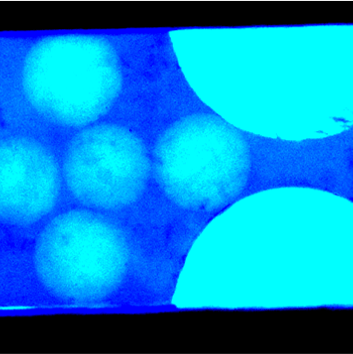
Tailoring Turbulent-Like Mixing with Polymer Solutions
See our recent publication in the Proceedings of the National Academy of Sciences, where we report a simple, robust, versatile, and predictive way to mix fluids in porous media—where slow diffusion in laminar flows typically limits mixing—using a chaotic flow instability in polymer solutions.
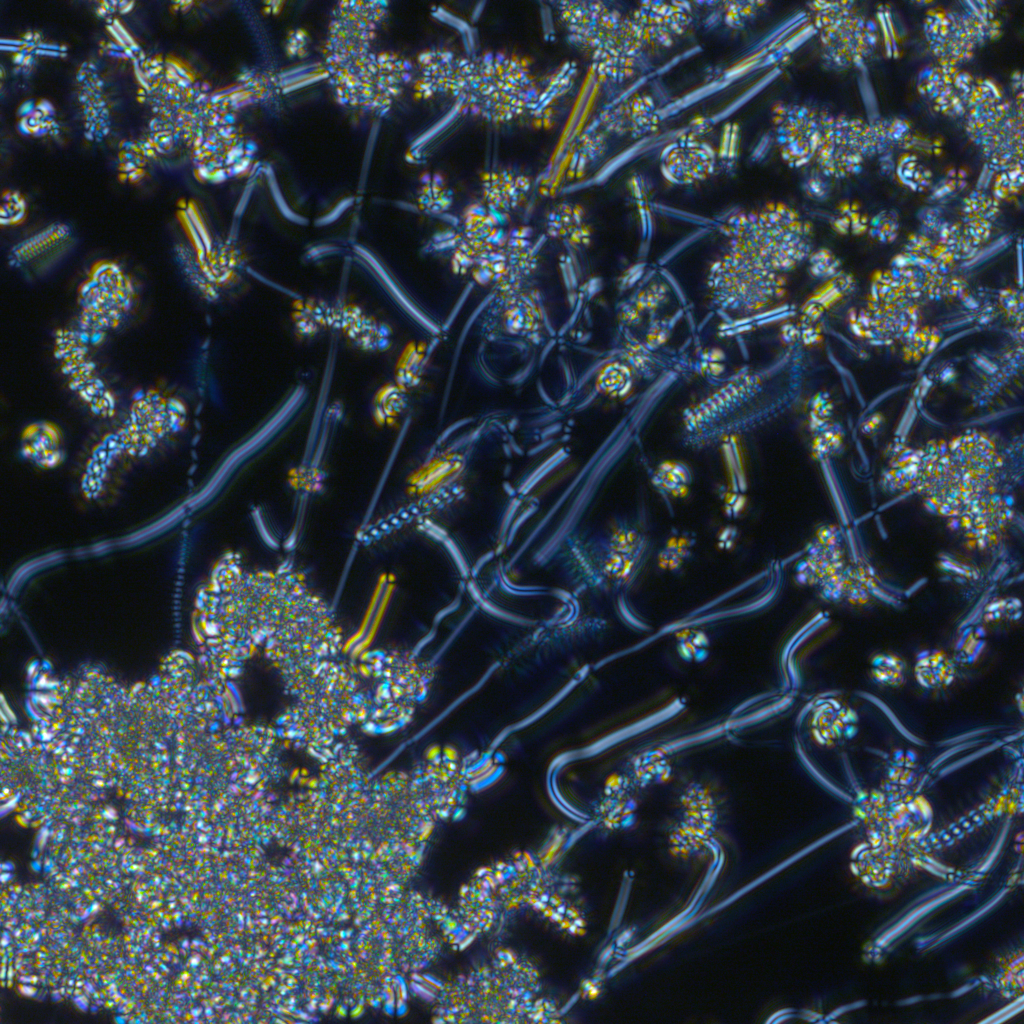
Constructing Condensate Networks with Liquid Crystals
See our recent publication in the Proceedings of the National Academy of Sciences, where we report the spontaneous formation of condensate networks with life-like dynamics, formed by the phase separation of liquid crystal solutions.
 Browne Lab