
Liquid-liquid phase separation plays an important role in a wide range of material synthesis processes and in understanding cellular protein condensates. However, many of these fluids are composed of anisotropic or fibrous molecules, which drastically affect the dynamics of phase separation, which in some cases remain far from equilibrium. I am currently interested in the emergent active dynamics that care arise during the phase separation of liquid crystalline mixtures.
During phase separation of a liquid crystal from an isotropic fluid, the elastic stresses associated with smectic alignment can drive the transient formation of filamentous, coiled, and disc-shaped structures. These structures grow rapidly, generating spontaneous flows and chaotic dynamics, which dictate the evolution towards complex architectures that are kinetically arrested from complete coalescence. By understanding and controlling these dynamics, we hope to engineer novel microstructured materials with life-like dynamics, and understand how phase separation of anisotropic fluids might be utilized in nature to drive non-equilibrium processes.
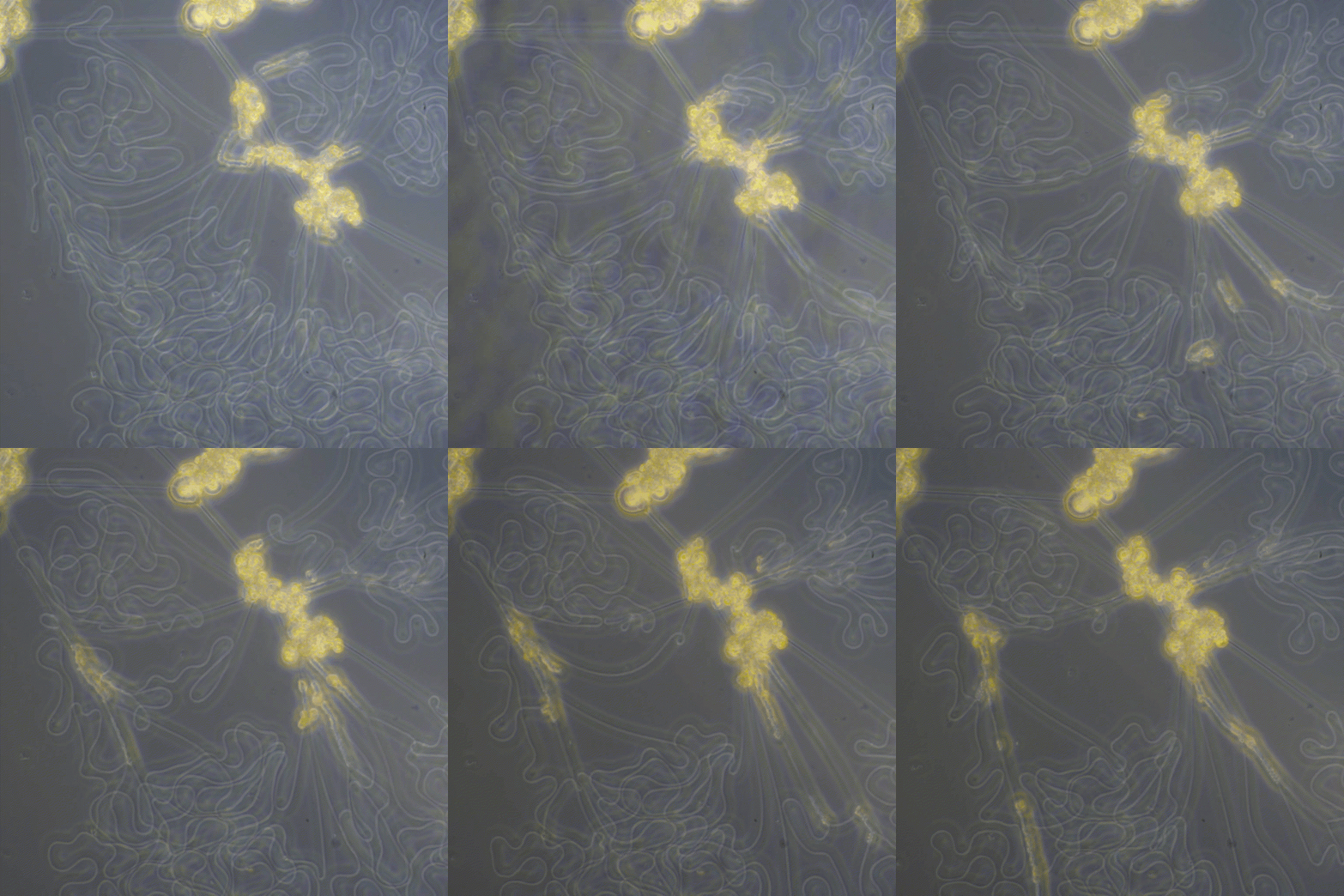
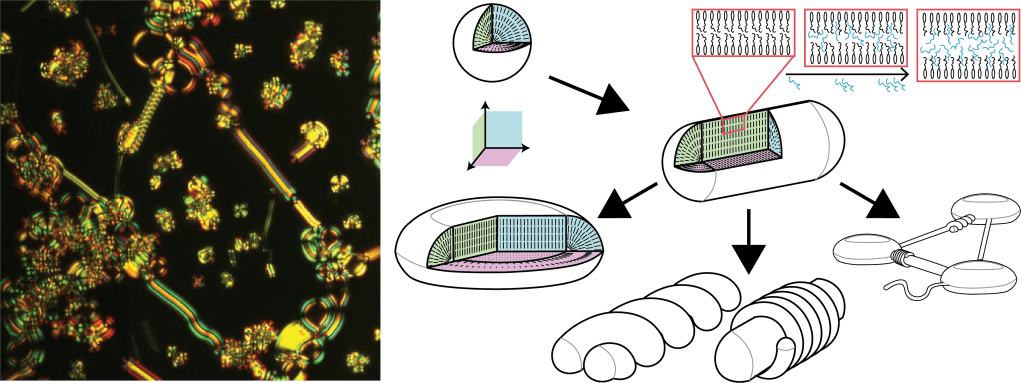
Tuning geometry of liquid crystal condensates with solvent
Many phase separated systems can form dispersed droplets that exhibit internal liquid crystalline ordering. The elasticity of the internal liquid crystalline mesophase often reshapes the droplet geometry, resulting in structures such as filaments, tactoids, tori, surface facets, and in some cases sparse networks with life-like dynamics. We investigate how choice of mesogen, solvent, and concentration can dramatically alter these networks. Using X-ray scattering, we observe that the solvent swells the smectic layers, seemingly reducing the smectic layer’s bend modulus, altering the geometric structure of the network. These results demonstrate some of the structural diversity of dispersed droplet geometries that can be accessed by LLCPS, and elucidate some of the requisite conditions for them to form networked morphologies.

Filamentous phase separation of liquid crystals
Proceedings of the National Academy of Sciences
Liquid-liquid phase separation, whereby two liquids spontaneously demix, is ubiquitous in industrial, environmental, and biological processes. While isotropic fluids are known to condense into spherical droplets in the binodal region, these dynamics are poorly understood for structured fluids. Here, we report the novel observation of condensate networks, which spontaneously assemble during the demixing of a mesogen from a solvent. Condensing mesogens form rapidly-elongating filaments, rather than spheres, to relieve distortion of a simultaneously-forming internal smectic mesophase. As filaments densify, they collapse into bulged discs, lowering the elastic free energy. Additional distortion is relieved by retraction of filaments into the bulged discs, which are straightened under tension to form a ramified network. Understanding and controlling these dynamics may provide new avenues to direct pattern formation or template materials.
 Browne Lab