
Polymers additives provide engineering control over industrial, health, and environmental flows. In many cases these polymers can produce elastic turbulence, an elastic flow instability characterized by strong velocity fluctuations in space and time reminiscent of traditional inertial turbulence. I combine device fabrication, confocal microscopy, and theory to understand how complex porous geometries influence this instability, and connect these microscopic fluctuations to macroscopic transport outcomes.
Enhanced mixing and reactions
Proceedings of the National Academy of Sciences
Watch our video summary on YouTube!
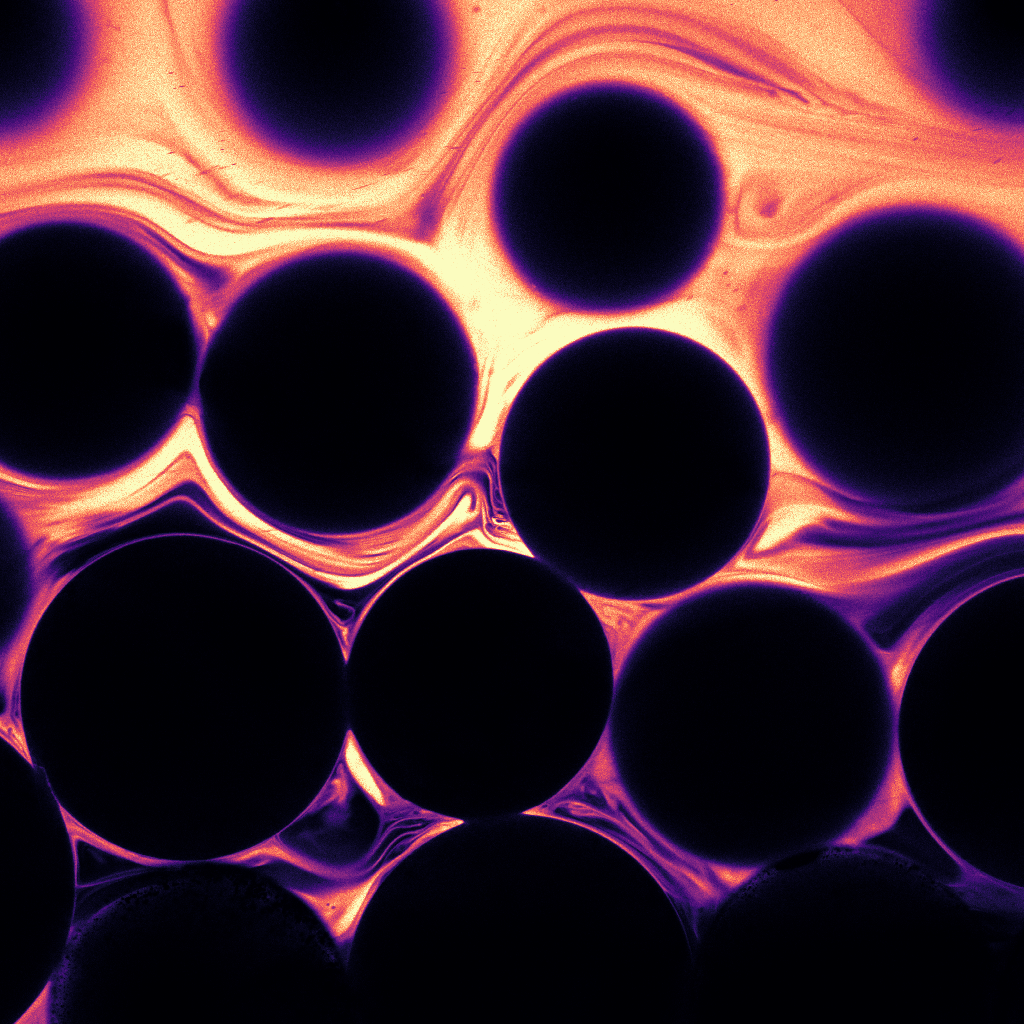
Here, we introduce a simple, robust, versatile, & predictive way to mix fluids in porous media—where slow diffusion in laminar flows typically limits mixing. 🌪️💧
Turbulence has been used for millennia to mix solutes—a familiar example is stirring cream into coffee! But many processes rely on the mixing of solutes in porous media, where confinement suppresses inertial turbulence (Reynolds numbers much less than 1). As a result, mixing is drastically hindered. This is a particular issue in flow reactors used for chemical production, where incomplete mixing limits reaction yield & throughput. Our solution is simple: just add a sprinkling of flexible polymers, whose stretching in the flow gives rise to an elastic instability (EI). By visualizing flow & solute in 3D porous media, we showed that EI generates turbulent-like chaotic flows in a porous medium. These greatly enhance mixing—reducing the mixing length by 3x, increasing dispersion by 6x, & chemical reaction yield by 3x! Motivated by the imaging, we developed a turbulence-inspired model of the underlying transport processes. It quantitatively rationalized the EI-imparted enhancements in mixing & reaction kinetics—yielding guidelines for applications in energy, environmental, & industry. We’re excited to keep exploring this fascinating interplay between elastic flow instabilities, solute transport & mixing, and chemical reactions.

Flow homogenization in stratified media
Many key environmental, industrial, and energy processes rely on controlling fluid transport within subsurface porous media. These media are typically structurally heterogeneous, often with vertically-layered strata of distinct permeabilities—leading to uneven partitioning of flow across strata, which can be undesirable. Here, using direct in situ visualization, we demonstrate that polymer additives can homogenize this flow by inducing a purely-elastic flow instability that generates random spatiotemporal fluctuations and excess flow resistance in individual strata. In particular, we find that this instability arises at smaller imposed flow rates in higher-permeability strata, diverting flow towards lower-permeability strata and helping to homogenize the flow. Guided by the experiments, we develop a parallel-resistor model that quantitatively predicts the flow rate at which this homogenization is optimized for a given stratified medium. Thus, our work provides a new approach to homogenizing fluid and passive scalar transport in heterogeneous porous media.
Porous individualism in 3D packings
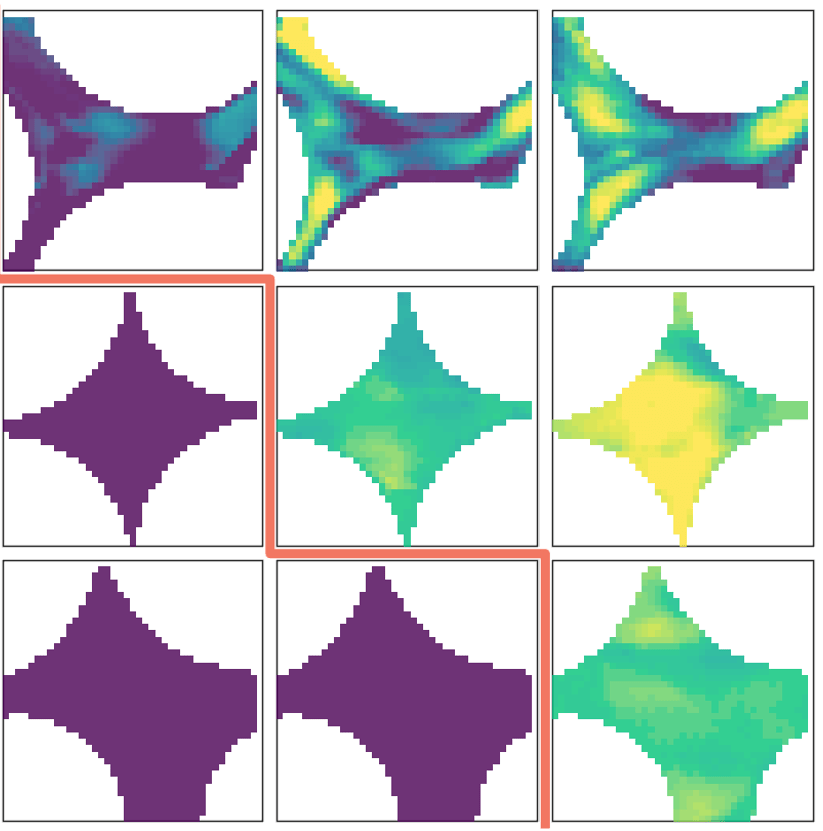
Many applications of elastic turbulence occur in disordered 3-D porous spaces, but it is still unknown what elastic turbulence looks like in 3-D. We fill this gap in knowledge by directly imaging the pore-scale fluctuating flow, finding the flow does indeed become unstable. Above a critical flow rate, individual pores show a continuous transition to an unstable flow with spectral features analogous to inertial turbulence. However, this critical onset varies pore to pore, creating a spatially patchy flow where unstable pores coexist with laminar pores via porous individualism. By combining PIV measurements of microscopic fluctuations with theory, we show for the first time how this elastic turbulence produces an excess flow resistance, much like traditional turbulence, resolving an over 50-year-old puzzle. Read more on Quanta or Scientific American!
Simulated multistability in linear arrays
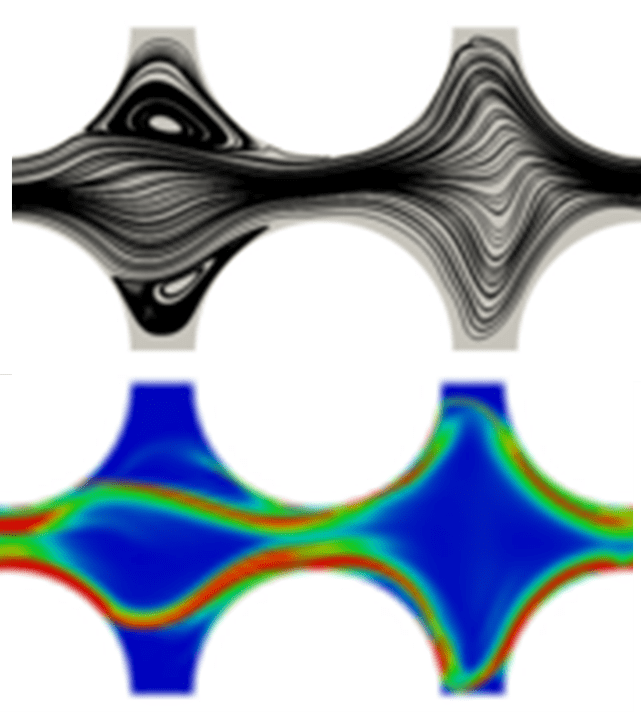
Following up on our work describing the bistability of flow structures in linear pore arrays, our collaborators in the Ardekani group (Purdue University) simulated the dynamic unstable flow. We showed how the generation of distinct flow states is linked closely to advected polymer stress.

Bistability in linear arrays
Elastic turbulence is understood well in single constrictions or obstructions, but less well in successive expansions and contractions like those found in porous media. By tuning the pore-throat (constriction) separation, we show how the unstable flow structure between pores becomes coupled when polymer memory persists longer than the advection time scale. This coupling results in a surprising bistability in flow state, where each pore adopts one of two distinct unstable flow structures: eddy dominated and eddy free. This signifies a large departure from previous assumptions that elastic turbulence is statistically similar between pores.
 Browne Lab